
GSL Visual Dictionary
Explore 108 common Ghanaian Sign Language signs across 14 categories. Each entry describes hand shape, movement, and cultural context.
Showing 108 signs
Hello
Wave your open hand side to side at shoulder height, palm facing outward. Accompanied by a friendly facial expression.
Good Morning
Sign GOOD (flat hand moves from chin forward) then MORNING (dominant forearm rises from horizontal to upright, representing the sun rising).
Good Afternoon
Sign GOOD then AFTERNOON — dominant forearm tilts at a 45° angle downward from upright, representing the sun's afternoon position.
Good Evening
Sign GOOD then EVENING — dominant forearm drops from upright to nearly horizontal, representing sunset.
How are you?
Point index finger toward the person, then sign HOW (both fists placed knuckles-together, twist outward) and bring the sign back toward the person. Use a questioning facial expression.
I am fine
Point to yourself (I), then touch your chest with an open hand and move it forward smoothly (FINE). A calm, positive expression accompanies this sign.
Thank you
Touch your chin or lips with the fingertips of your flat hand, then move the hand forward and slightly downward, as if offering something with gratitude.
Please
Place your flat dominant hand on your chest and rub in a circular motion. The movement is gentle and conveys politeness.
Goodbye
Open hand with palm facing outward, fingers together. Wave the hand side to side or open-close the fingers repeatedly.
Sorry / Excuse me
Make a fist with your dominant hand (A-hand) and rub it in a circle on your chest. Accompanied by a regretful facial expression.
Welcome
Extend your open hand outward from your body and sweep it inward in a welcoming gesture, as if inviting someone to come closer.
My name is…
Point to yourself (MY), then tap the side of your index and middle fingers together twice at forehead level (NAME), then fingerspell your name.
Letter A
Make a fist with the thumb resting alongside the fingers (not tucked in). Palm faces the viewer.
Letter B
Hold your hand up with all four fingers extended straight and together, thumb folded across the palm. Palm faces the viewer.
Letter C
Curve all fingers and thumb into a C-shape, as if holding a cup. Palm faces sideways.
Letter D
Touch the tip of your thumb to the tips of your middle, ring, and pinky fingers, while the index finger points straight up.
Letter E
Curl all four fingers down to touch the thumb, forming a tight, rounded shape. Palm faces the viewer.
Letter F
Touch the tip of your index finger to the tip of your thumb forming a circle. Extend the other three fingers straight up.
Letter G
Extend your index finger and thumb parallel to each other, pointing sideways. Other fingers are curled. Shares handshape with L but differs in orientation.
Letter H
Extend index and middle fingers together, pointing sideways. Other fingers and thumb are curled.
Letter I
Make a fist with only the pinky finger extended straight up. Palm faces the viewer.
Letter J
Start with the I-hand (pinky up), then trace a J-shape in the air by sweeping the pinky downward and curving it.
Letter K
Extend index and middle fingers in a V, with the thumb touching the middle finger at the middle knuckle. Shares handshape with P.
Letter L
Extend your index finger up and thumb out to the side, forming an L-shape. Other fingers are curled. Shares handshape with G.
Letter M
Place your thumb under your first three fingers (index, middle, ring) which drape over the thumb. Palm faces down.
Letter N
Place your thumb under your first two fingers (index and middle) which drape over the thumb. Palm faces down.
Letter O
Curve all fingers to meet the thumb, forming a round O-shape. Like holding a small ball.
Letter P
Same handshape as K (V-hand with thumb touching middle finger) but with the hand pointing downward.
Letter Q
Same handshape as G (index and thumb parallel) but with the hand pointing downward.
Letter R
Cross your index and middle fingers (index in front). Other fingers and thumb are curled. Palm faces the viewer.
Letter S
Make a fist with the thumb wrapped across the front of the fingers. Palm faces the viewer.
Letter T
Place your thumb between your index and middle fingers, with all fingers curled into a fist.
Letter U
Extend index and middle fingers together, pointing upward. Other fingers and thumb are curled. Same shape as H but pointing up.
Letter V
Extend your index and middle fingers apart in a V-shape. Other fingers and thumb are curled. Palm faces the viewer.
Letter W
Extend your index, middle, and ring fingers apart. Thumb and pinky are curled. Palm faces the viewer.
Letter X
Make a fist, then bend your index finger into a hook shape. Palm faces sideways.
Letter Y
Extend your thumb and pinky finger, curl the other three fingers. Like a "hang loose" gesture. Palm faces the viewer.
Letter Z
Extend the index finger and trace the letter Z in the air in front of you with a zigzag motion.
One (1)
Hold up your index finger with the palm facing the viewer. Other fingers and thumb are curled.
Two (2)
Extend your index and middle fingers in a V-shape. Palm faces the viewer.
Three (3)
Extend your thumb, index, and middle fingers. Ring and pinky are curled.
Four (4)
Extend all four fingers (index through pinky) with the thumb folded across the palm.
Five (5)
Open your entire hand with all five fingers spread apart. Palm faces the viewer.
Ten (10)
Hold up your hand in a fist with the thumb extended upward, then twist/shake the wrist.
One hundred (100)
Sign ONE then the letter C. The C-hand represents "century" or hundred.
Mother
Tap your thumb on your chin twice with an open hand (fingers spread). The chin area represents the female/mother reference point.
Father
Tap your thumb on your forehead twice with an open hand (fingers spread). The forehead area represents the male/father reference point.
Child
Hold your dominant hand flat, palm facing down, at about waist height. Move it up and down slightly, as if indicating the height of a small person.
Brother
Sign MALE (thumb on forehead) then bring both index fingers together side by side, indicating a same-level family relationship.
Sister
Sign FEMALE (thumb on chin) then bring both index fingers together side by side, indicating a same-level family relationship.
Baby
Cradle your arms in front of your body as if holding a baby, and rock them gently side to side.
Family
Both hands form F-hands (thumb and index touching, others extended). Start with hands together in front, then circle them outward and bring them back together, forming a circle representing the family unit.
Eat / Food
Bring your flattened O-hand (fingertips and thumb together) to your mouth repeatedly, as if putting food in your mouth.
Drink
Form a C-hand as if holding a cup and tilt it toward your mouth, mimicking the action of drinking.
Water
Make a W-hand (three fingers extended) and tap the index finger to your chin twice.
Rice
Cup both hands together, palms up, as if holding a mound of rice. Wiggle the fingers slightly to suggest grains.
Bread
Hold your non-dominant hand flat (representing a loaf) and use the dominant hand to make slicing motions across it.
Fish
Hold your dominant hand flat with fingers together, palm facing sideways. Move it forward in a wavy motion, mimicking a fish swimming.
Hospital
Use your dominant index finger to draw a cross (+) on your upper arm, representing the medical cross symbol.
Doctor
Tap the wrist of your non-dominant hand with the fingertips of your dominant hand, as if taking a pulse. Then sign PERSON.
Medicine
Use the middle finger of your dominant hand to make a small circular motion on the upturned palm of your non-dominant hand, as if grinding medicine.
Sick / Ill
Place your dominant middle finger on your forehead and your non-dominant middle finger on your stomach. Both hands use the 5-handshape with the middle finger bent.
Pain / Hurt
Point both index fingers toward each other and twist them in opposite directions near the area of pain. Accompanied by a pained facial expression.
Help
Place your dominant fist (thumb up) on the flat palm of your non-dominant hand. Lift both hands upward together.
School
Clap your flat hands together twice, as if a teacher clapping for attention. The motion is parallel and rhythmic.
Teacher
Hold both flat hands near your temples, palms facing each other, and move them forward twice (as if presenting knowledge). Then sign PERSON.
Student
Hold your non-dominant flat hand palm-up (representing a book), and with your dominant hand, pick up information from it and bring it to your forehead (absorbing knowledge).
Book
Place both flat hands together (palms touching, like a closed book), then open them outward as if opening a book.
Learn
Hold your non-dominant hand flat, palm up. With your dominant hand, pick up from the flat palm and bring fingertips to your forehead, as if putting knowledge into your head.
Write
Pinch your dominant thumb and index finger together (as if holding a pen) and make a writing motion across the flat palm of your non-dominant hand.
Today
Point both flat hands downward in front of your body and lower them slightly, indicating the present moment — "right here, right now."
Tomorrow
Touch your thumb to your chin with the A-hand, then move it forward and slightly upward, pointing toward the future.
Yesterday
Touch your thumb to your chin with the A-hand, then move it backward over your shoulder, pointing to the past.
Morning
Rest your non-dominant arm horizontally (the horizon). Place your dominant flat hand in the crook of the elbow and raise it upward, representing the rising sun.
Night
Rest your non-dominant arm horizontally. Bend your dominant hand over it at the wrist, curving the fingers downward like the sun setting below the horizon.
Happy
Brush your flat hand upward on your chest repeatedly (2 times). The upward movement represents positive feelings rising.
Sad
Hold both open hands in front of your face, palms inward, then draw them downward while letting your expression droop. The downward motion mirrors falling spirits.
Angry
Hold your hand open in front of your face (claw-like, fingers bent) and pull it away forcefully. Use an intense facial expression.
Love
Cross both fists over your chest (arms crossed), as if hugging yourself. This represents holding something precious close to your heart.
Afraid / Scared
Both open hands start in front of your body and move toward each other with a shaking motion, as if trembling with fear. Use a frightened expression.
Go
Point both index fingers forward and move them away from your body in an arc. The motion indicates moving away or departing.
Come
Point both index fingers toward yourself and beckon them inward. The motion indicates approaching or arriving.
Work
Make fists with both hands. Tap the dominant fist on top of the non-dominant fist twice, like hammering. Represents productive labour.
Sleep
Place your open hand against the side of your face (like a pillow) and tilt your head toward it. Close your eyes briefly.
Walk
Hold both hands flat, palms down. Alternate moving them forward in a walking motion, mimicking feet stepping.
Give
Hold your flat O-hand (fingertips together) near your body, then move it forward toward the person you're addressing, opening the fingers as you extend.
Home / House
Touch your fingertips together (flat O-hand) at your cheek near your mouth, then move the hand up to your temple area. Represents where you eat and sleep.
Market
Hold both flat O-hands in front of your body, then rotate them forward repeatedly at the wrists, as if exchanging goods. Represents buying and selling.
Church
Place the thumb of your dominant C-hand on the back of your non-dominant fist, then tap twice. The C represents the church structure on a foundation.
Ghana
Fingerspell G-H-A-N-A, or use the established GSL name sign: a G-hand that taps the chest.
Red
Touch your index finger to your lower lip, then draw it downward. The lip reference relates to the red colour of the lips.
Black
Draw your index finger across your forehead from one side to the other, as if indicating a dark line.
White
Place your open hand on your chest, then pull it away while closing the fingers, as if pulling out whiteness.
Green
Make the G-handshape and shake it slightly. The initialized sign uses the first letter of the English word.
Yellow
Make the Y-handshape (pinky and thumb extended) and shake it. Another initialized sign.
What?
Hold both hands out, palms up, and shake them slightly side to side. Use a questioning facial expression (eyebrows raised).
Where?
Point your index finger and wave it side to side. Eyebrows are furrowed (WH-question expression).
Who?
Point your index finger forward and draw a small circle with it. Eyebrows are furrowed.
When?
Hold your non-dominant index finger upright. Circle the tip of your dominant index finger around it, then land on the tip. Eyebrows furrowed.
Why?
Touch your forehead with your middle finger, then bring the hand forward, changing to a Y-handshape. Eyebrows furrowed.
How?
Place both fists together (knuckles touching), then twist them outward so palms face up. Raised eyebrows.
Yes
Make a fist (S-hand) and nod it forward, as if the fist is a head nodding yes.
No
Extend your index and middle fingers and snap them shut against your thumb, like a mouth closing. Repeat once.
Money
Tap the back of your flat non-dominant hand with your dominant flat O-hand (fingertips together), as if placing coins.
Phone / Telephone
Extend your thumb and pinky from a fist (Y-hand), hold it to your ear like a telephone receiver.
Car
Hold both hands up as if gripping a steering wheel, and move them as if turning the wheel.
Clothes
Brush both open hands downward on your chest repeatedly, as if smoothing your clothing.
Door
Hold both B-hands side by side, palms facing out, then swing one of them open to the side (like a door opening on a hinge).
GSL Fingerspelling & Handshapes
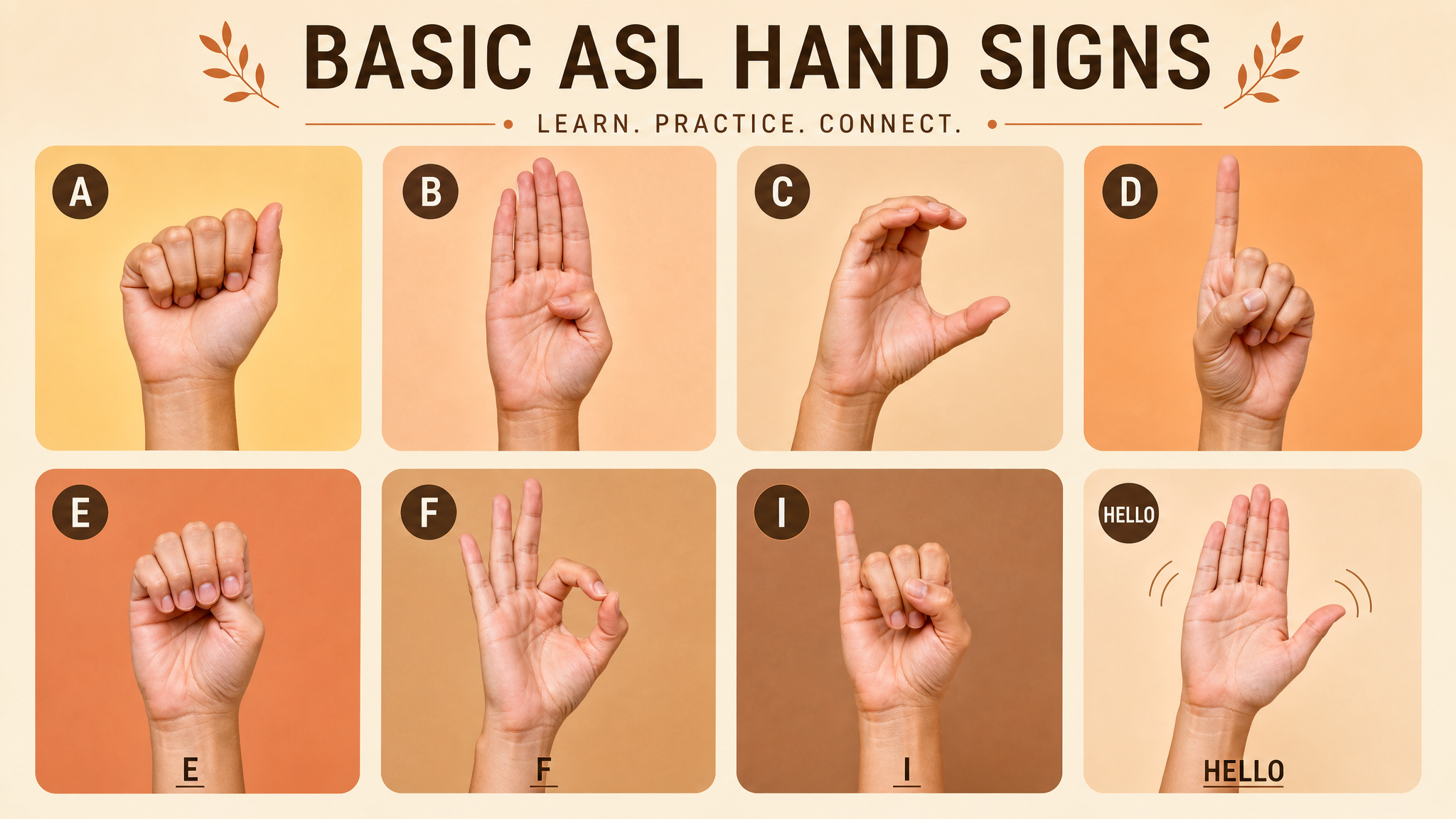
The GSL manual alphabet uses 22 distinct handshapes to represent 26 English letters. Some letters share the same handshape and are distinguished only by palm orientation or movement.
Shared Handshape Pairs
- H ↔ USame shape, different orientation
- K ↔ PSame shape, different orientation
- G ↔ LSame shape, different orientation
- I ↔ JSame shape — J adds a hooking motion
Fingerspelling Tips
- Keep your hand steady — don't bounce with each letter
- Maintain eye contact, not hand contact
- Use the same dominant hand throughout
- Don't let your hand block your face
- Letters J and Z are the only ones with movement
GSL in Daily Life
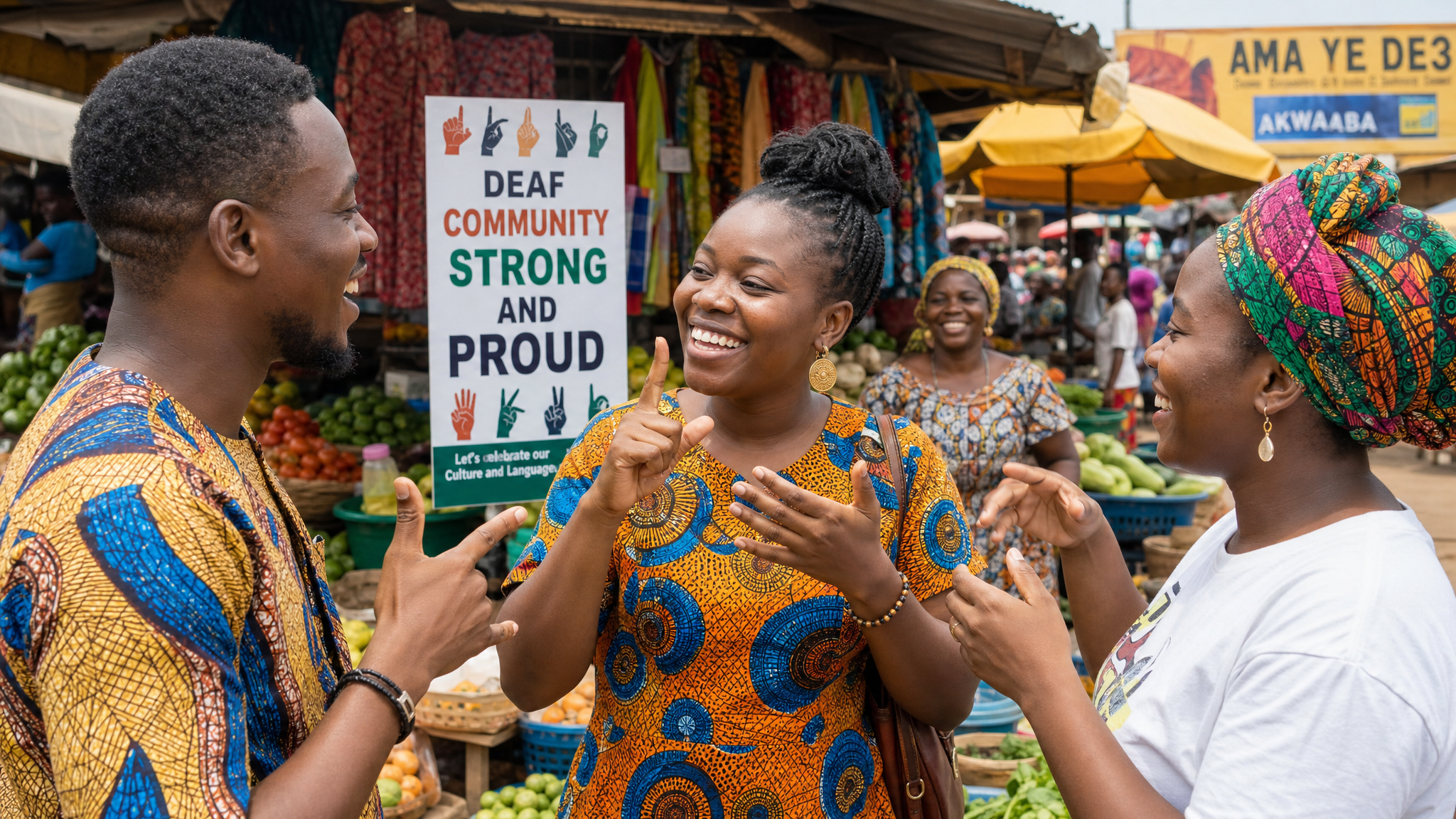
Ghanaian Sign Language is a living language used daily in markets, schools, churches, and homes across Ghana. Introduced in 1957 by Andrew Jackson Foster (the “Gallaudet of Africa”), GSL has evolved its own unique vocabulary distinct from American Sign Language. The 2021 Harmonised GSL Dictionary, developed by the Ghana Education Service with UNICEF and GNAD, standardises signs across all regions for the first time.
Learn More — External Resources
For video demonstrations, download these apps or visit the online dictionaries. The Zenodo and Kaggle datasets are available for researchers and developers.
Zenodo GSL Lexicon
1,200+ signs with OpenPose skeletal data. CC BY 4.0.
Fragkiadakis, Nyst & Nyarko — Leiden University / University of Ghana
HANDS! Lab GSL App
1,300+ signs with video. Free, offline-capable.
HANDS! Lab, Leiden University
GhSL Dictionary App
2,300+ words & sentences with video and quizzes.
Leslie Kojo Okyere
Ayele Foundation GSL Dictionary
Online searchable dictionary with video entries.
Ayele Foundation
SignTalk-GH Dataset
10,000 healthcare GhSL videos. Open access on Kaggle.
RAIL, KNUST
Harmonised GSL Dictionary
Official standardised dictionary by Ghana Education Service.
Ghana Education Service, UNICEF Ghana, GNAD
Explore More African Sign Languages
This dictionary covers Ghanaian Sign Language. Visit our main Sign Languages page to learn about South African, Kenyan, Nigerian, and other African sign languages.