African Sign Languages
Africa is home to over 40 distinct sign languages serving approximately 40 million people with hearing loss. From South African Sign Language — now the country's 12th official language — to village sign languages that have thrived for centuries, this page explores the rich diversity of signing across the continent.
Sign Language Diversity Across Africa
There is no single "African Sign Language" — the continent hosts dozens of distinct sign languages, each with unique grammar, vocabulary, and cultural identity.
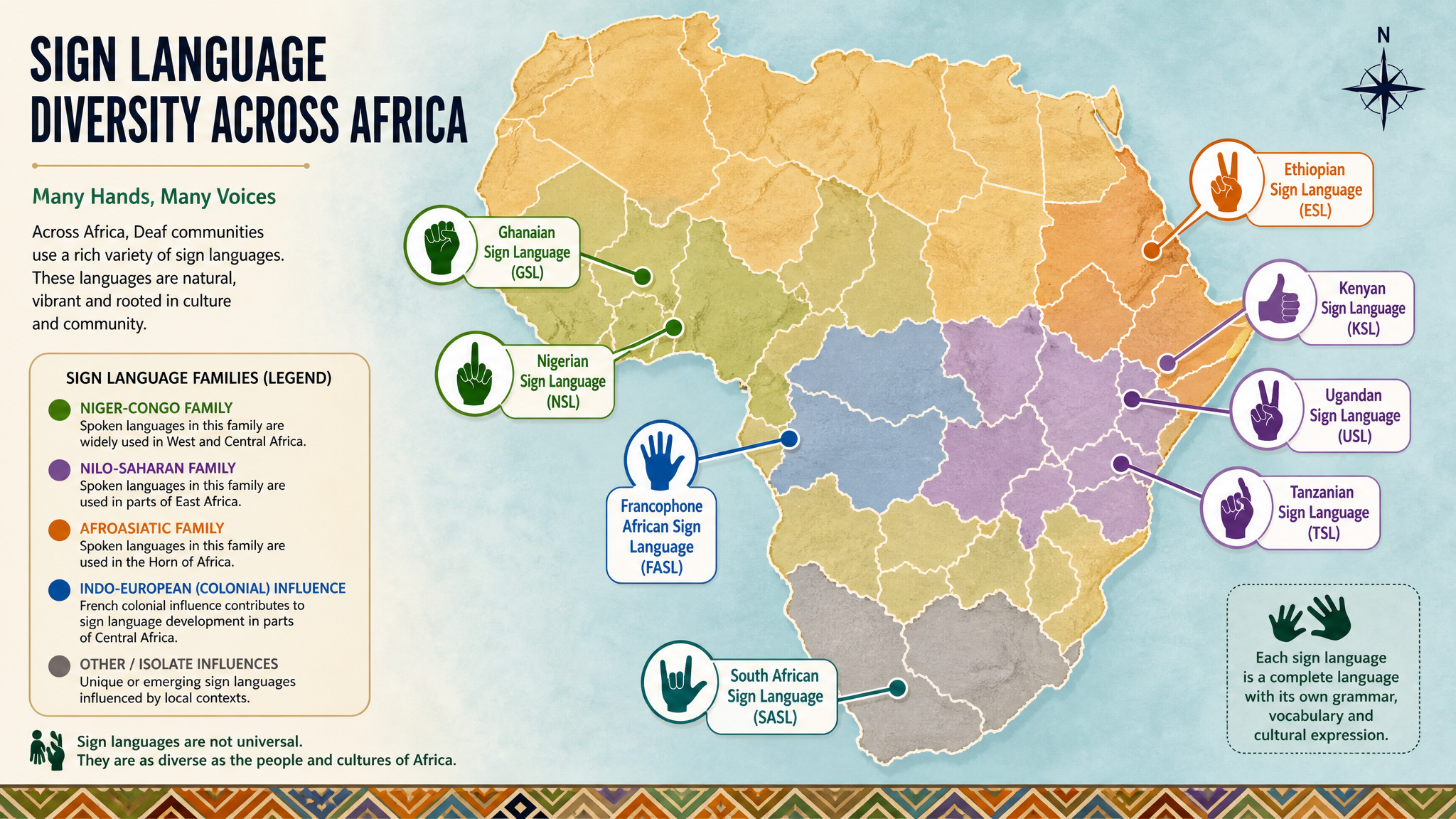
Illustrative map — actual sign language boundaries are fluid and overlapping. Countries may host multiple sign languages.
Major African Sign Languages
Explore the primary sign languages used across the continent, their recognition status, and resources for learning
Common Signs Across African Sign Languages
While each sign language is unique, here are descriptions of common greetings and phrases in SASL, GSL, and KSL
Open hand raised near the side of the forehead, then moved outward in a wave-like motion — similar to a friendly salute.
Wave the open hand with palm facing outward at chest height. Similar to the ASL greeting.
Open palm waved at shoulder height, often accompanied by a smile and direct eye contact.
Important Note
Sign languages are visual languages — written descriptions can only approximate what the signs look like. To learn signs accurately, we strongly recommend video-based resources and, ideally, learning directly from Deaf community members. The descriptions above are simplified guides, not substitutes for proper instruction.
Fingerspelling
Many African sign languages use one-handed fingerspelling systems derived from ASL. Fingerspelling is used for proper nouns, technical terms, and words without established signs.
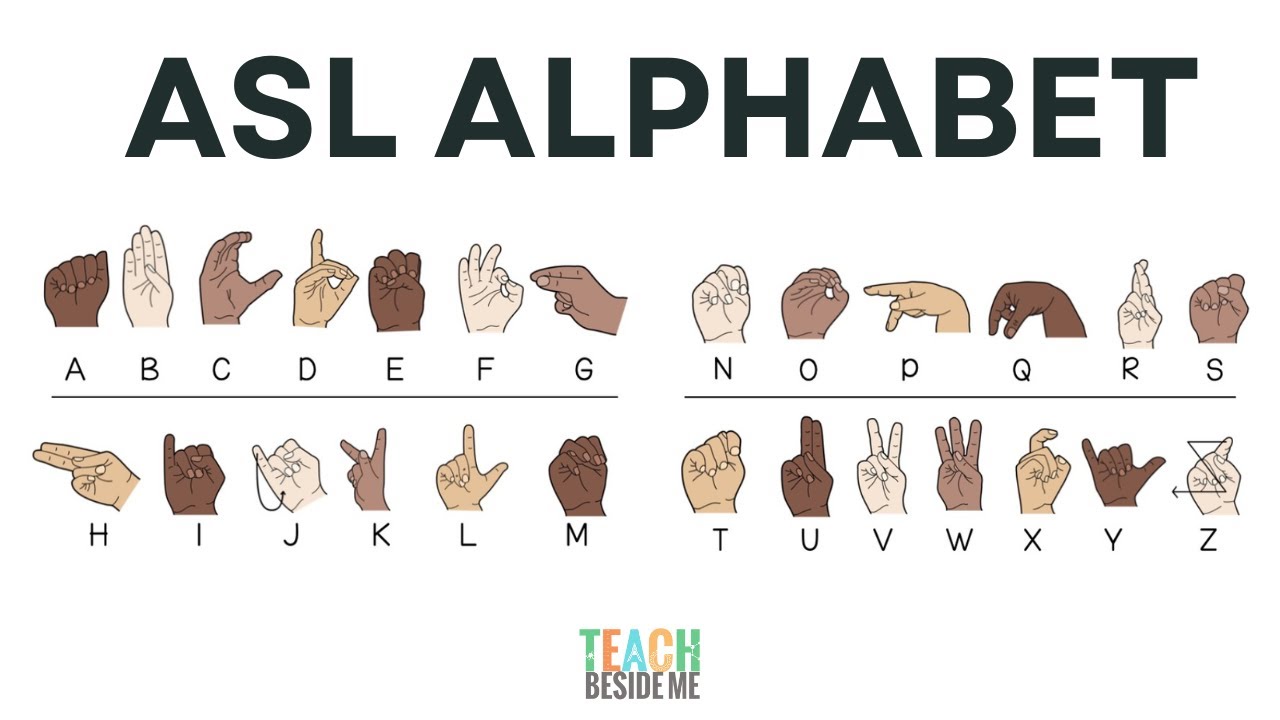
One-Handed Manual Alphabet
This fingerspelling chart shows the hand shapes used in many African sign languages including GSL, KSL, and others derived from the ASL manual alphabet. In Ghanaian Sign Language, 22 distinct handshapes represent 26 letters — pairs like "h" & "u", "k" & "p", "g" & "L" share handshapes and are distinguished by movement or orientation.
Maintain Eye Contact
Look at the person you\'re communicating with, not at your own hand while fingerspelling.
Keep Hand Steady
Don\'t move your hand horizontally or bounce it. Keep it in one stable position at shoulder height.
Use Consistent Hand
Use your dominant hand throughout the entire word. Don\'t switch hands mid-word.
Village Sign Languages
Some of Africa\'s most fascinating sign languages emerged naturally in rural communities with high rates of hereditary deafness. These village sign languages are often distinct from the national sign languages.
Adamorobe Sign Language (AdaSL)
Ghana — Used in the village of Adamorobe, one of the oldest documented village sign languages in Africa. Distinct from GSL.
Tebul Sign Language
Mali — Village sign language used in communities with high congenital deafness rates.
Bura Sign Language
Nigeria — Used in northeastern Nigeria, distinct from the school-based Nigerian Sign Language.
Dogon Sign Languages
Mali — Multiple sign language varieties used in Dogon communities in Mali.
Nanabin Sign Language
Ghana — Village sign language used in northern Ghana, documented by researchers at the University of Ghana.
Why African Sign Languages Matter
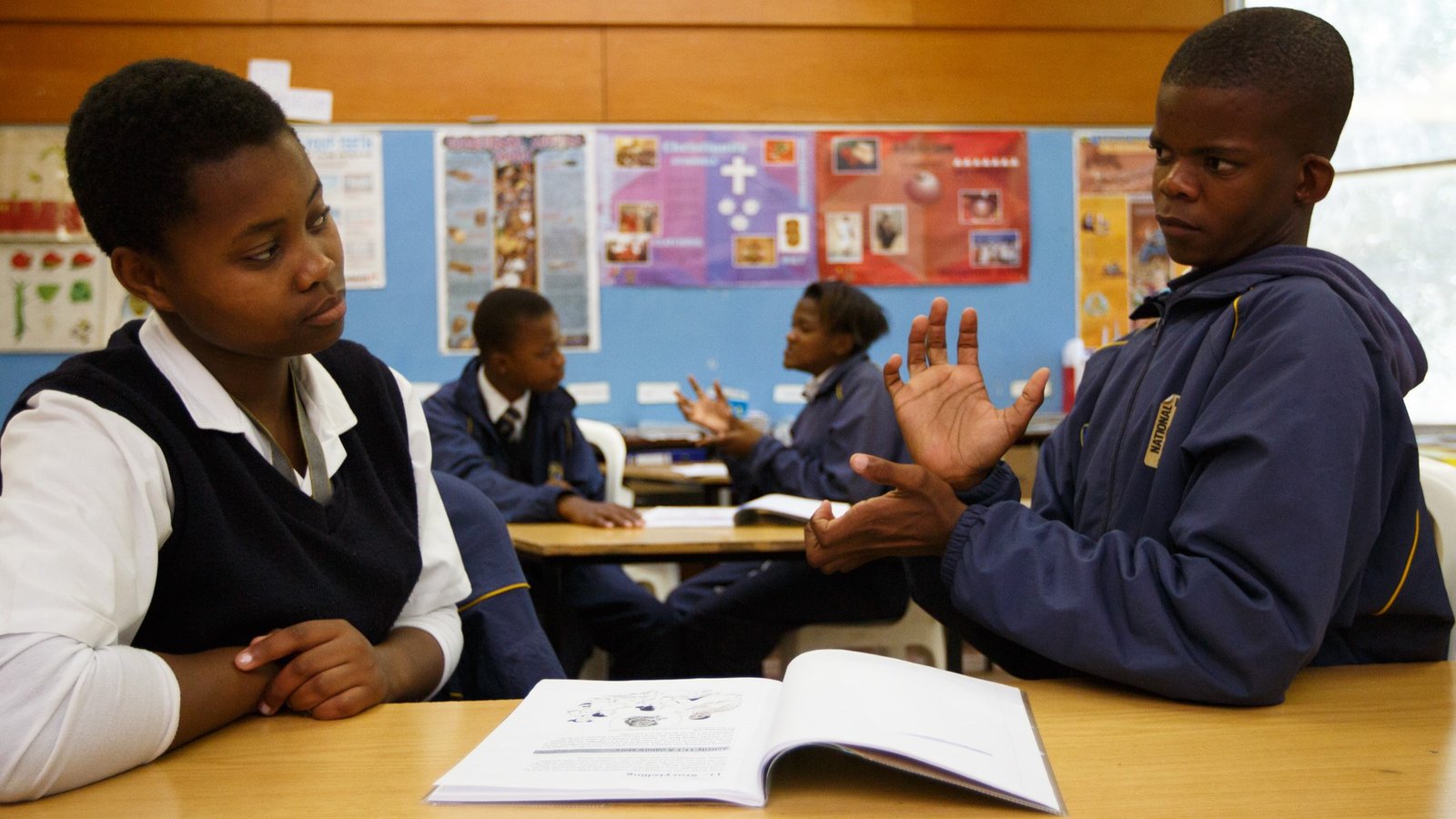
Approximately 40 million people in Africa live with hearing loss, yet only four countries — South Africa, Kenya, Uganda, and Zimbabwe — have constitutionally recognized sign language. This gap means millions of Deaf Africans lack access to education, healthcare, legal services, and public information in their primary language.
Sign languages are not visual versions of spoken languages. They have their own grammar, syntax, and cultural identity. Ghanaian Sign Language is not "English in gestures" — it is a complete, natural language with its own rules.
Supporting African sign languages means supporting linguistic diversity, cultural preservation, and the fundamental right of every person to communicate and access information.
Open Research & Datasets
The AI and linguistics community is making important progress in documenting and building technology for African sign languages
AfriSign (2025)
Video-to-text translation dataset covering sign languages from 6 African countries: Ghana, Nigeria, Kenya, Zambia, Zimbabwe, and South Africa. 94.6% accuracy in multilingual translation.
Read the paperSignTalk-GH (2026)
10,000 healthcare-domain sign language videos for Ghanaian Sign Language. Designed for AI-driven recognition and doctor-patient communication.
View on KaggleGSL Lexicon 1.0
1,200+ Ghanaian Sign Language signs with OpenPose skeletal data, recorded at the University of Ghana. Free and open access on Zenodo.
Access on ZenodoAfrican Sign Languages Resource Center
Comprehensive profiles of sign languages and Deaf culture across all 54 African countries. Documentation, advocacy, and education.
Visit resource center